
Summarize this blog post with:
Local search has evolved far beyond simply showing up for “near me” queries. With 40.16% of local business queries triggering AI responses, users are getting answers without clicking – and rankings alone can no longer explain why visibility does or doesn’t convert into real business outcomes.
The problem isn’t a lack of data; it’s relying on outdated signals that don’t reflect how AI-driven local SERPs actually surface, interpret, and recommend businesses.
The solution is better measurement. Modern local SEO requires metrics that reflect how often you’re discovered, how users engage, and whether that visibility turns into real-world action. When you track the right local SEO metrics, you can identify what’s working, what’s holding you back and where to focus next.
In this article, you’ll explore the top 10 local SEO metrics that actually matter in 2026, how AI is reshaping local search performance, and how to track and automate local SEO metrics using Two Minute Reports to prove ROI to your clients.
Let’s get started.
Why is Tracking Local SEO Metrics Important?
As local SERPs become more AI-driven and action-oriented, you need reliable local SEO metrics that clearly explain performance and justify ongoing investment. Here’s why it matters:
1. The Shift From Rankings to Action
- Zero-click searches dominate local results, reducing the relevance of traditional click-based metrics.
- AI-generated summaries influence which businesses users trust before they engage.
- Google Business Profile actions (calls, direction requests, etc) are now the primary conversion layer for local SEO.
Takeaway: Tracking these signals helps you understand the overall impact, not just visibility.
2. ROI Accountability in Local SEO
Local SEO is often one of the highest-intent channels – but only if performance is tied to outcomes, not the visibility alone.
- Metrics must connect local optimization efforts to revenue, leads, or store visits, not vanity rankings.
- Research shows that local SEO can deliver 3X higher ROI for SMEs, but only when tracked correctly.
- For agencies, client retention increasingly depends on demonstrating measurable, business-level impact.
Takeaway: Clear measurement turns local SEO from a trust-based channel into a provable growth driver.
3. Competitive Intelligence
Local SEO metrics don’t just measure performance. They expose competitive gaps.
- Tracking geographic visibility helps reveal underserved locations and expansion opportunities.
- Review volume, velocity, and sentiment reflect how your brand compares within the local market.
- NAP consistency and listing accuracy directly influence trust, prominence and ranking stability.
Takeaway: Without tracking these signals, competitive shifts go unnoticed until performance declines.
4. Managing Multi-location complexity
As you onboard new clients serving businesses across regions, local SEO performance tracking becomes complex and time-consuming.
- Individual locations often perform differently due to competition, demand and engagement patterns.
- Manual tracking doesn’t scale and leads to delayed, fragmented insights.
- Consistent, location-level metrics enable faster optimization and standardized reporting.
Takeaway: Use a reliable SEO reporting software to streamline multi-location SEO across different clients and scale without operational bottlenecks.
The need for tracking actionable metrics becomes more critical when you factor in how AI now shapes local discovery and decision-making. As AI systems increasingly influence which businesses are recommended, agencies must rethink what they measure and how they report it.
How is AI Reshaping Local SEO Marketing and Reporting?
If you can adapt your measurement to reflect AI-driven local search behavior, you will be better positioned to improve performance, guide strategy, and strengthen client relationships. Here’s how AI plays a crucial role in impacting local SEO:
- AI-driven local discovery: AI summaries now influence which local businesses users see and trust, making contextual relevance more important than traditional rank position.
- Sentiment-based evaluation: Review themes, language patterns, and response quality matter more than star ratings in how AI systems assess and recommend businesses.
- Conversational search interpretation: Local queries are longer and intent-driven, requiring measurement beyond fixed keywords to capture how businesses appear for real user questions.
- Competitor analysis: AI enables continuous tracking of competitor visibility, review momentum, and listing changes across service areas.
- Predictive reporting: Automated reporting tools track anomalies and trends early, enabling agencies to address visibility, reviews, and listing issues before performance drops.
This shift toward AI-led discovery makes tracking the right local SEO metrics more critical than ever.
Essential Local SEO Metrics to Track
In this section, let’s explore the top 10 local SEO metrics categorized based on the following:
- Visibility Metrics – Foundation Layer
- Engagement Metrics – Middle Layer
- Reputation Metrics – Trust Layer
Visibility Metrics
These metrics answer: Can users see you, and where? Visibility metrics establish the baseline for every conversion action.
1. Local Pack Rankings
What it measures: Your business’s position in Google’s Local Map Pack for local-intent queries across different geographic points.
Why it matters: Tracking Local Pack Rankings helps you understand where Google considers your business most relevant. For agencies, this metric sets the foundation for local discoverability – but only when viewed geographically, not as a single averaged position.
Optimization tip:
Improve rankings by aligning all local ranking pillars simultaneously:
- Relevance – service categories, on-page signals, GBP completeness.
- Prominence – reviews, citations, brand signals.
- Proximity influence – service area clarity and location optimization.
2. Geographic Visibility Score
What it measures: How consistently your business appears in local search results across different neighbourhoods, cities, or service areas – often visualized through grid-based heat maps.
Why it matters: Local SEO performance is rarely uniform. Many businesses rank well near their physical location but lose visibility even a few miles away. A Geographic Visibility Score reveals these blind spots and shows whether your local presence actually matches your service reach.
Optimization tip:
- Identify low-visibility areas and create pages focused specifically on those areas.
- Encourage reviews from customers in underperforming locations.
- Optimize your Google Business Profile to better match those service areas.
Treat low-visibility locations as growth opportunities, not as failures.
3. Local Organic Rankings
What it measures: Your position in traditional organic search results for location-based and local-intent keywords outside the Map Pack.
Why it matters: Not all users convert directly from maps. Many scroll past the local pack to research options, compare services or validate credibility. Local organic rankings matter more for services where customers research and validate businesses before taking action, rather than calling immediately from the map results.
This metric complements Map Pack Visibility by showing how well your business competes in research-driven local searches.
Optimization tip:
- Focus on local pages built around real user intent.
- Make each page clearly relevant to a specific location and the problems customers are trying to solve.
- Go beyond “[service] + city” by explaining when, why, and how your service helps.
4. Local Share of Voice
What it measures: The percentage of times your business appears in local results compared to the competitors across your target keywords and service areas. Use reliable local SEO tools such as BrightLocal, Local Falcon, etc., to measure SoV accurately.
Why it matters: Rankings show where you appear, but Share of Voice shows how dominant you are in the local market. A business with moderate rankings but with high SoV signals has more popularity than one ranking first in a few isolated spots.
Optimization tip:
- Expand coverage by targeting additional service areas and category keywords.
- Close competitive gaps where competitors appear consistently and you don’t.
- Strengthen visibility in underperforming locations identified through grid tracking.
Intent & Engagement metrics
These metrics answer: “How do users find you and what do they do after discovering your business?”
5. Google Business Profile Actions
What it measures: Direct actions taken on your Google Business Profile, such as calls, directions requests, website clicks, bookings, and messages.
Why it matters: These actions represent real local intent. GBP actions show when users are actively considering your business as an option. For many local businesses, this is the closest measurable step to conversion before a sale actually happens.
Optimization tip:
- Improve profile completeness and accuracy to reduce friction before action.
- Use compelling photos and clear service descriptions to increase interaction.
- Show that you genuinely care about customers by actively responding to their inquiries and reviews.
- Track action trends by location to identify high-intent versus low-intent markets.
6. Discovery vs Direct Searches
What it measures: The ratio of users who find your business through non-branded searches (category or service-based) to those who search for your business name directly.
Why it matters: Discovery searches indicate new demand and competitive reach, while direct searches signal brand recognition and returning interest. Together, they show whether growth is coming from market expansion or brand familiarity.
Optimization tip:
- Increase discovery searches by strengthening category relevance and local visibility.
- Compare discovery trends across locations to spot underperforming markets.
- Build localized content that clearly matches search intent and supports topical authority.
7. GBP Views (Search vs Map)
What it measures: The distribution of your profile views between Google Search and Google Maps.
Why it matters: Search and Maps views reflect different intent stages. Search-driven views often indicate problem-solving behavior, while Maps views signal navigational or proximity-based intent. Understanding this breakdown helps explain engagement quality, not just total exposure.
Optimization tip:
- Optimize GBP descriptions and services to strengthen search-driven visibility.
- Pair view data with GBP actions to identify which channels drive the most engagement.
- Use photos, categories, and attributes to stand out in Maps discovery.

Track search impressions, website visits, phone calls, direction requests, views on maps, and reviewer insights in a single GMB template. Understand what actually brings in customers and optimize your GMB profile with confidence.
Reputation Metrics (Trust Layer)
These metrics answer: “Why should users trust you?” Reputation determines the scalability of your local business's authenticity and credibility.
8. Review Velocity and Volume
What it measures: The rate at which new reviews are acquired over time (velocity) and the total number of reviews a business has received (volume).
Why it matters: Review velocity signals business activity and relevance, while review volume builds credibility and social proof. A steady flow of recent reviews reassures both users and algorithms that a business is active, trusted, and consistently chosen, especially in competitive local markets.
Optimization tip:
- Build a repeatable review request process tied to real customer interactions.
- Encourage reviews consistently rather than for short, one-time campaigns.
- Compare review acquisition pace across locations to spot stagnation early.
9. Average Star Rating and Review Sentiment
What it measures: Your overall star rating combined with the underlying sentiment and themes within customer reviews.
Why it matters: Star ratings influence whether users click, but sentiment explains why. Search engines and users look beyond averages to understand patterns – service quality, responsiveness, pricing, or recurring complaints. Strong sentiment reinforces trust, while unresolved issues weaken credibility even with acceptable ratings.
Optimization tip:
- Address recurring negative themes instead of chasing higher averages.
- Respond to reviews with clarity and accountability.
- Capitalize on the key strengths customers repeatedly mention in your messaging.
10. NAP Consistency Score
What it measures: The accuracy and consistency of your business name, address, and phone number across directories, listings, and data aggregators.
Why it matters: NAP Consistency reinforces trust. Inconsistent information creates uncertainty for both users and search engines, leading to a decline in business legitimacy and stability. While it’s not a growth lever, it’s a foundational trust requirement that critically supports all other local SEO efforts.
Optimization tip:
- Standardize business details and apply them uniformly across listings.
- Audit directories periodically to catch formatting and naming variations.
- Treat NAP cleanup as maintenance, not a one-time task.
Local SEO success doesn’t come from a single metric or report; it comes from understanding how visibility, engagement and reputation work together. For agencies and multi-location brands, this layered approach transforms local SEO from a ranking system into a measurable growth framework.
How to Measure Local SEO Metrics Using Two Minute Reports?
Below is a practical, step-by-step way to measure local SEO performance using Two Minute Reports.
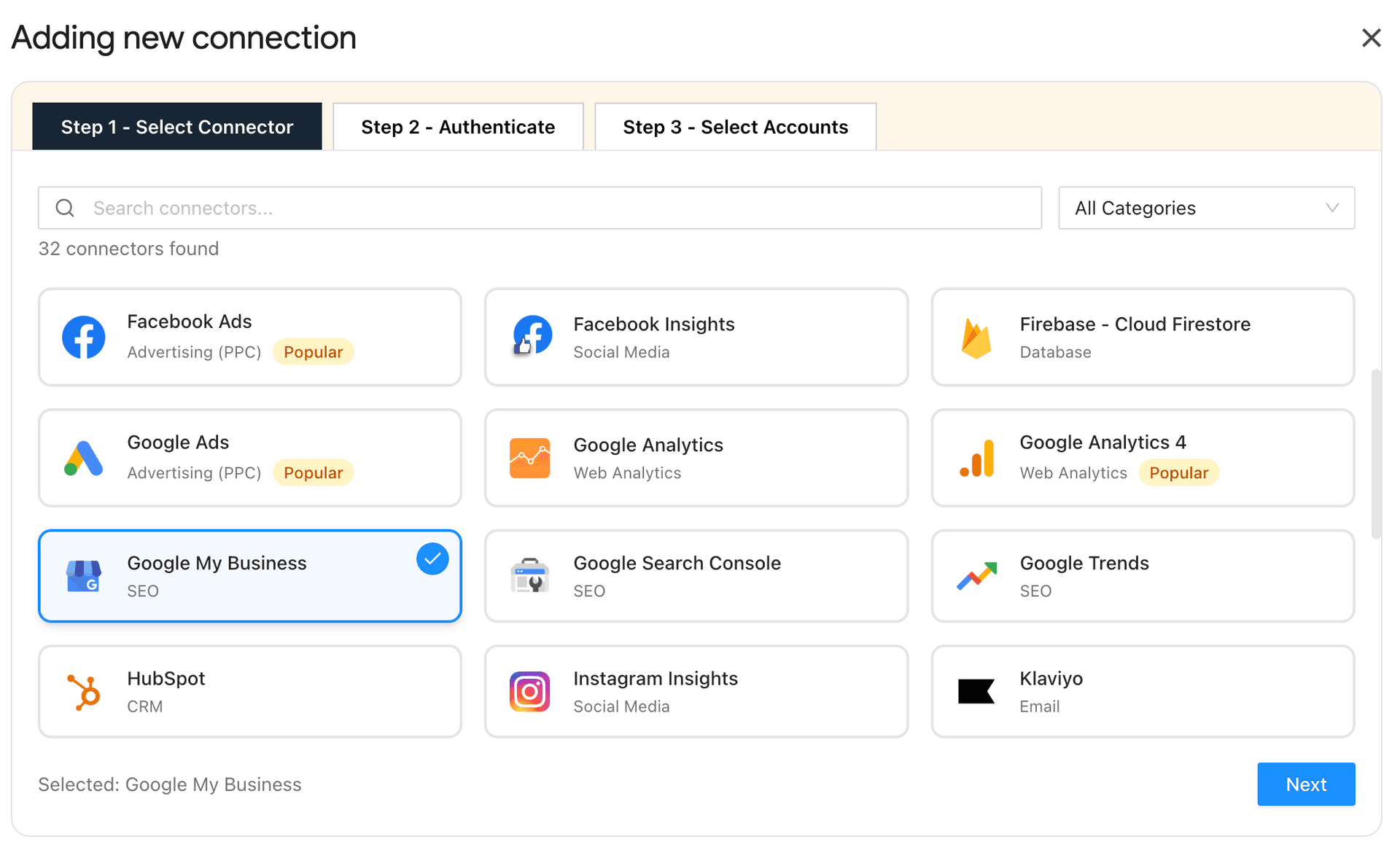
Step 1: Connect your GBP accounts
- Install the Two Minute Reports add-on from Google Workspace Marketplace and launch it in your spreadsheet.
- Next, connect your client’s Google Business Profile accounts with Google Sheets (follow the on-screen instructions to authenticate your credentials).
- Easily manage multiple clients and locations from a single interface.

Step 2: Select key metrics that align with your goals
- Group metrics by location to compare performance across service areas.
- Track Search vs. Maps views to understand user intent and discovery patterns.
- Pair key customer actions such as calls, direction requests, website clicks, bookings, and messages with visibility data to see what drives actual engagement.
Step 3: Customize your report to measure performance
- Build data-driven GBP reports and dashboards that combine rankings, visibility trends, and conversion actions.
- Add custom logo, colors, and interactive elements to reinforce your agency’s branding – no premium upgrade required.
- Extract GBP data in the format you need and build unlimited real-time dashboards that always stay up to date.
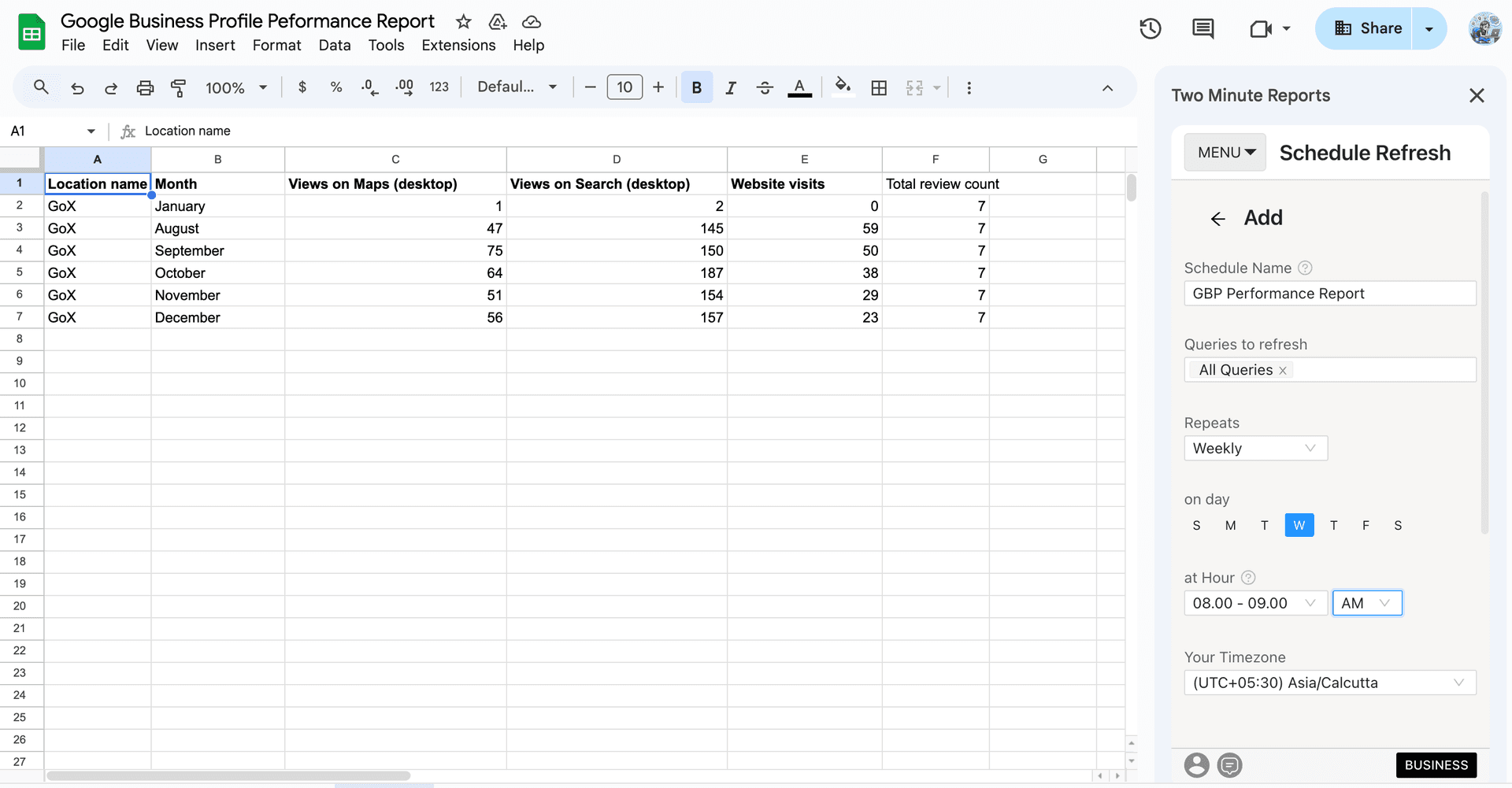
Step 4: Automate your report
- Schedule your local SEO reports to auto-update daily, weekly or monthly.
- Identify performance drop-offs, scale what’s working, and optimize using live GBP data.
- Share action-driven GBP insights via email, live links or downloadable PDFs.

Translate Local SEO Metrics into Action
Tracking metrics only matters if they guide action. The key is interpreting those signals correctly and responding with strategic adjustments, not reactive changes. Below are the common performance scenarios, what they indicate, and how to respond effectively.
1. Strong Visibility, Weak GBP Actions
What it means: You’re being discovered, but users aren’t convinced enough to act. The issue isn’t reach; it’s persuasion or clarity.
What to check:
- Star rating and review sentiment.
- Profile completeness (services, categories, attributes).
- Whether competitors have stronger social proof.
- Quality and recency of photos.
What to do next:
- Improve review acquisition and highlight positive themes.
- Rewrite service descriptions to clearly state outcomes.
- Strengthen primary category and service alignment.
- Add recent, high-quality photos for credibility.
2. High Discovery Searches, Low Direct Searches
What it means: You’re capturing new demand, but not building brand recall. Users find you, but don’t remember you.
What to check:
- Consistency of brand messaging across locations.
- Website clarity and trust signals.
- Review response tone.
- Whether offline marketing reinforces brand identity.
What to do next:
- Strengthen brand positioning within Google Business Profile descriptions and posts.
- Encourage satisfied customers to mention your brand name in reviews.
- Improve on-site messaging to reinforce credibility.
- Align local SEO with offline branding efforts.
3. Strong Reviews, Weak Geographic Coverage
What it means: Your trust signals are strong, but Google doesn’t associate your business with broader service areas.
What to check:
- Localized landing pages for nearby neighbourhoods.
- Citation consistency tied to secondary areas.
- Analyze whether the reviews are coming from only one zone.
What to do next:
- Build location-specific pages with clear service relevance.
- Actively collect reviews from underperforming areas.
- Optimize content and GBP services for geographic expansion.
- Strengthen internal linking to nearby service areas.
4. Competitors Gaining Visibility
What it means: You’re not necessarily declining, but competitors are improving faster.
What to check:
- Competitor review velocity compared to yours.
- Map pack presence across key service areas.
- New content, offers, or promotions that competitors are highlighting.
- Changes in competitor categories, services or GBP attributes.
What to do next:
- Reassess primary and secondary categories for competitive alignment.
- Verify whether your business information is accurate across all listings.
- Audit your current review acquisition process and refine it to exceed the competitor pace.
- Look for strategic gaps, analyze where you stand and implement necessary changes.
Wrapping Up
Local SEO is about interpreting signals and driving valuable decisions. For agencies and in-house marketers, this competitive advantage comes from tracking the right layers of data and knowing how to respond when patterns shift. Here are the key takeaways:
- Visibility explains opportunity – If you’re not discoverable across service areas, nothing else matters.
- Intent metrics reveal quality of demand – Actions, discovery ratios, and channel behavior show how close users are to choosing you.
- Reputation determines selection – Reviews, sentiment, and trust signals influence whether visibility turns into revenue.
- Flat metrics don’t mean stable performance – Competitors can gain market share while your dashboard appears unchanged.
- Track performance in real-time – Use a dedicated reporting tool such as Two Minute Reports to sync metrics across multiple locations and track performance in real time to spot opportunities and areas of improvement.
Start measuring what truly matters and turn your local SEO metrics into measurable growth. Try Two Minute Reports free for 14 days and experience the difference for yourself.
Frequently Asked Questions
Tracking local SEO metrics is important because it helps you understand the overall impact of your efforts, connects optimization to real business outcomes, and reveal competitive gaps. It also aids in managing multi-location complexities and demonstrates measurable growth to clients.
Visibility metrics measure how often users can see your business in local search results. They establish a baseline for conversions by answering questions like "Can users see you, and where?" The common visibility metrics include Local Pack Rankings, Geographic Visibility, Local Organic Rankings and Local Share of Voice.
Google Business Profile Actions refer to direct actions taken on your Google Business Profile, such as calls, direction requests, website clicks, bookings, and messages. These actions indicate real local intent from users.
To measure local SEO performance using Two Minute Reports, you first connect your Google Business Profile accounts, select key metrics that align with your goals, customize your report, and then automate it (daily, weekly or monthly) to stay updated with real-time insights.
To improve local SEO rankings, focus on optimizing your Google Business Profile by ensuring completeness and accuracy, enhancing local content relevance, and encouraging customer reviews. Additionally, identify low-visibility areas and create targeted content to boost your presence in those regions.
Related Blogs




Meet the Author
Shalini MuruganShalini is driven by ideas that create a tangible impact. At Two Minute Reports, she specializes in content that helps marketers optimize their reporting workflows. When she's not transforming complex data into meaningful insights, you might find her lost in a book, jotting down ideas in her notebook, or connecting the dots others overlook.

