
Summarize this blog post with:
“Can you remove that table and explain the data with a line graph?”
“I need this XYZ client’s Q2 marketing report by 2 pm.”
“I don’t see a connection between these metrics. Can we modify and rewrite this section of the report?”
As a marketer, such questions can make even the most seasoned professional break out in a cold sweat, especially when juggling multiple client reports under tight deadlines. We all have been there.
Getting started on a marketing report is just the beginning. To make it truly actionable, you need to experiment with different formats, decide which metrics matter the most, and present them in a way that tells a compelling story.
You might wonder: How do I kickstart this process? Is there a better way to accomplish this?
No worries. In this article, we’ll explore the best practices for creating marketing reports that communicate your insights and next steps. You’ll discover what works best, how to present the necessary information and make informed choices that help you and your clients move forward with confidence.
Let's get started.
What is a Marketing Report?
A marketing report lets you collect, analyze, visualize, and share data with your marketing team, senior executives, and clients to support and enhance data-driven decisions.


Snapshot from a marketing report
For agencies, a marketing report is more than just a document – it’s a powerful tool that demonstrates your value to clients by showcasing the ROI of your efforts and the performance of their campaigns. By presenting clear, data-backed evidence, you build trust with your clients, showing them exactly how their marketing investments are paying off.
A good marketing report can be a game-changer in the following ways:
1. As a compass guiding you in your marketing initiatives
A well-crafted marketing report acts as a strategic compass, guiding your agency by turning data into actionable direction. It helps answer the key question: “What should be done next?”
2. Your go-to playbook for hunting the treasure trove
Your marketing reports are the clues that you can rely on to cross every hurdle. They reveal valuable insights into opportunities that drive effective results for your clients.
3. Be a go-getting marketer
With insights from marketing reports, agencies can become proactive partners. You can identify opportunities, optimize campaigns, and anticipate trends, positioning your agency as a trusted analytical expert.
4. Your creative canvas to test different experiments
Think of marketing reports as a creative canvas. They help you experiment with new strategies, refine goals, and present innovative ideas to keep clients engaged and excited.
5. The practical blueprint you could ever have
Effective marketing reports provide a step-by-step blueprint for scaling strategies. You can use them to stay ahead of the curve, adjusting to the competitive landscape and ensuring client success.
Now that you’ve got an idea of marketing reporting, in the next section, we’ll explore key insights to understand what goes into a great marketing report.
What Does a Great Marketing Report Look Like?
Key takeaway 1: Include only those KPIs that make absolute sense. Always less is more.
Your marketing report should be easy to process and deliver clarity without overwhelming your client with excessive data. When you include only the necessary metrics tied to your client’s business outcomes, you create a narrative that directly addresses their goals.
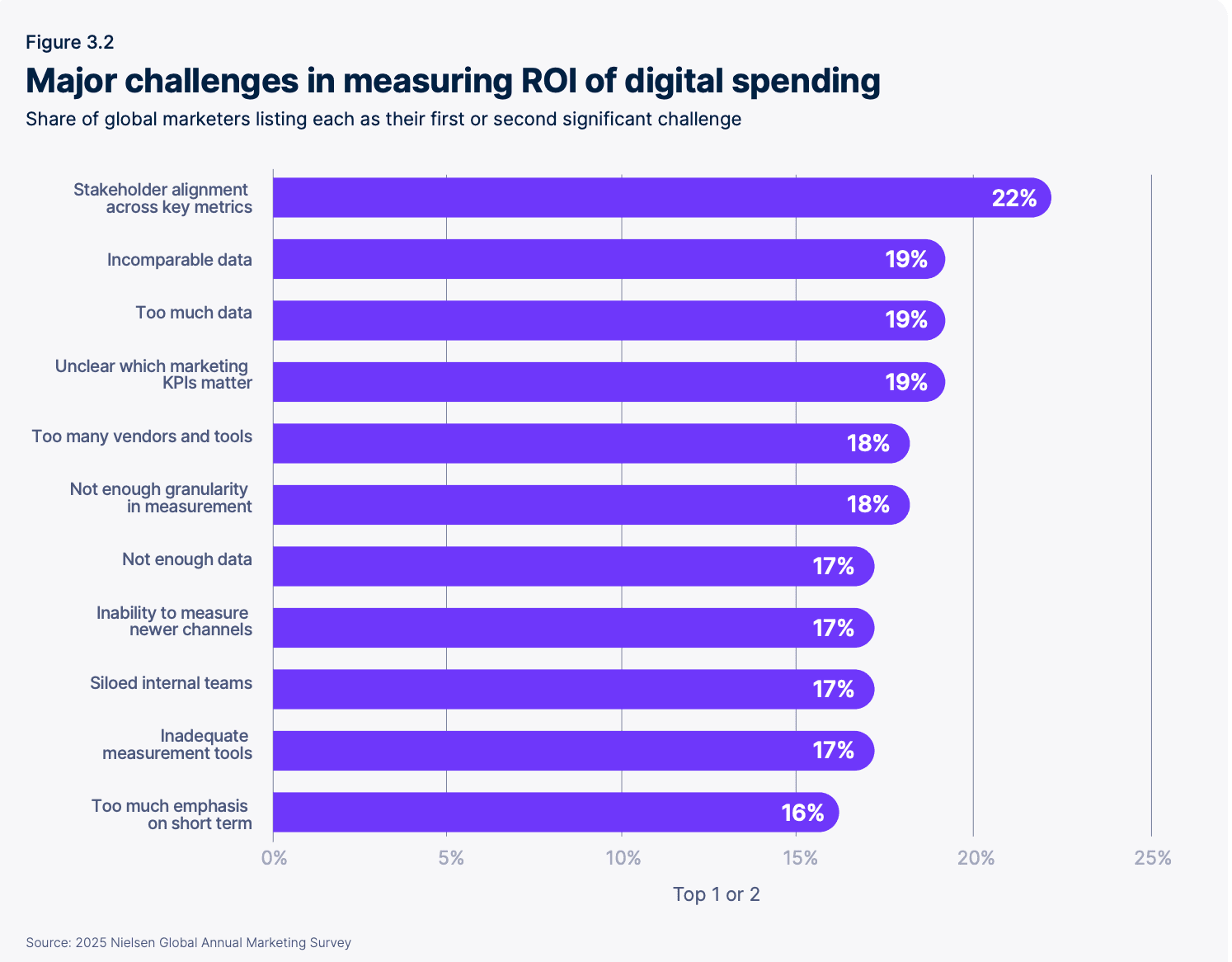
According to Nielsen’s 2025 Annual Marketing Survey, 22% of marketers stated that the stakeholders’ alignment across key metrics was the biggest challenge in measuring ROI. To be successful, you must have clear goals upfront and understand how to measure performance to create impactful reports.

For agencies, this not only showcases your strategic alignment but also reinforces your value, making it easier to retain clients and even upsell additional services based on their evolving needs.
Key Takeaway 2: Brainstorm and collect requirements from your clients on what insights need to be presented in the marketing report.
Imagine that your client requests a campaign performance report due tomorrow morning. You might assume that delivering a comprehensive report might quickly impress them. However, failing to understand their specific needs can lead to missed expectations, and your efforts may fall flat.
By tailoring reports to what truly matters to your client, you enhance satisfaction, build trust, and increase the likelihood of long-term retention and potential upselling.
Key Takeaway 3: Create a repeatable process. Use specific marketing report templates for the type of service you provide.
As an agency marketer, juggling multiple marketing reports across SEO, PPC, social media, email, and more can be daunting. Now, imagine you’ve just wrapped a report, only to have your client request additional details. Suddenly, you’re burning your daylight, scrambling to meet their needs. We’ve all been there.
So how do you address this major challenge?
Implementing a repeatable reporting process with customizable templates allows you to streamline your workflow, focus on high-value data, and deliver consistent insights that clients appreciate.
With real-time insights via interactive dashboards, pre-built templates for each report type, and the ability to extract and refine data, you can quickly adjust reports on the fly. This saves time and also ensures that your reports consistently deliver the value your clients expect, helping you build trust and retain clients.
How to Write a Marketing Report?
Understanding the fundamentals of great marketing reports is crucial, but the real challenge lies in putting them into action. Let’s understand in four simple steps on creating a marketing report.


1. Begin with a clear vision
A marketing report without a clear purpose is like setting sail without a map.
You’ll drift aimlessly, never knowing where to start or how to reach your destination. To avoid falling into this trap, ask yourself: What key insights or story am I trying to convey?
Once you have a defined purpose, half the battle is won. Your marketing report should be intent-driven, concise, and focused. Avoid jamming your client’s report with unnecessary data. Just keep it simple, relevant, and purposeful.
2. Know your target audience
Every report has a different audience, from internal stakeholders to clients with distinct needs. For instance, your marketing lead might be focused on campaign ROI while your client cares about the leads generated.
Understanding these needs is vital. Tailor your reports to reflect what matters most to each audience.
The more aligned your report is with its goals, the more value you provide and the stronger your client relationships will become. It should ideally tell them how it impacts their overall bottom line in an easy-to-understand format.
3. Gather only necessary data
As a digital marketing agency, you will be dealing with multiple clients and data streams. While it’s tempting to include every detail, a 50-page marketing report full of irrelevant data is a quick way to lose your target reader’s interest and focus.

Instead, pay attention to key metrics that add value to your client. This not only streamlines the marketing reporting process but also helps you deliver actionable insights that drive results. Using a reliable marketing reporting software, you can further reduce time spent on manual tasks, enabling you to concentrate on analysis and strategy.
4. Make your report visually appealing
A well-designed marketing report does more than just present data – it tells a story. But if your visuals are just a collection of bar charts and pie charts, they won’t have much impact.
To make your marketing reports visually compelling, you must first get clarity in your report design. Here’s how you can:
- Ensure your visuals are clear and align with your narrative.
- Think about the reporting context.
- Choose visuals that highlight the key data points.
- Use consistent design language that resonates with your brand.
Remember, a visually compelling marketing report can transform complex data into a powerful tool for strategic decision-making and client retention.
Seven Essential Marketing Report Examples with Templates
Now that you’ve got a 4-step framework for writing compelling marketing reports, it's time to understand how to incorporate these insights practically. In this section, we’ll explore the seven most crucial marketing report examples and templates that help you visualize data in a centralized dashboard.
1. PPC Marketing Report
With Two Minute Reports’ PPC marketing report templates, you can gather and analyze key ad metrics from platforms like Google Ads, Facebook Ads, LinkedIn Ads, TikTok Ads, Bing Ads, Pinterest Ads, and even Apple Search Ads.
Key PPC metrics to track:
- Cost per acquisition: The cost incurred to acquire one new customer.
- Click-through rate: The percentage of people who clicked on your ad after viewing it.
- Conversion rate: The percentage of users who completed a desired action.
- Return on Ad Spend: The revenue generated for every dollar spent on the ad campaign.
- Amount spent: The total budget spent on your advertising campaign.

2. SEO Marketing Report
Investing in organic marketing is a long-term strategy. To succeed, you must continuously monitor key SEO metrics such as website traffic, keyword rankings, and visitor engagement. Using the right SEO reporting templates, you can visualize actionable performance insights and take action to strengthen your online presence.
Key SEO metrics to track:
- Website traffic: Understand the source of your website visitors.
- Keyword rankings: Monitor where your website ranks for targeted keywords.
- Visitor engagement: Measure bounce rates, session duration and pages per visit.
- Page Speed: Track and optimize your website loading time for a better user experience.
- Local SEO: Keep tabs on your local listings and search visibility.

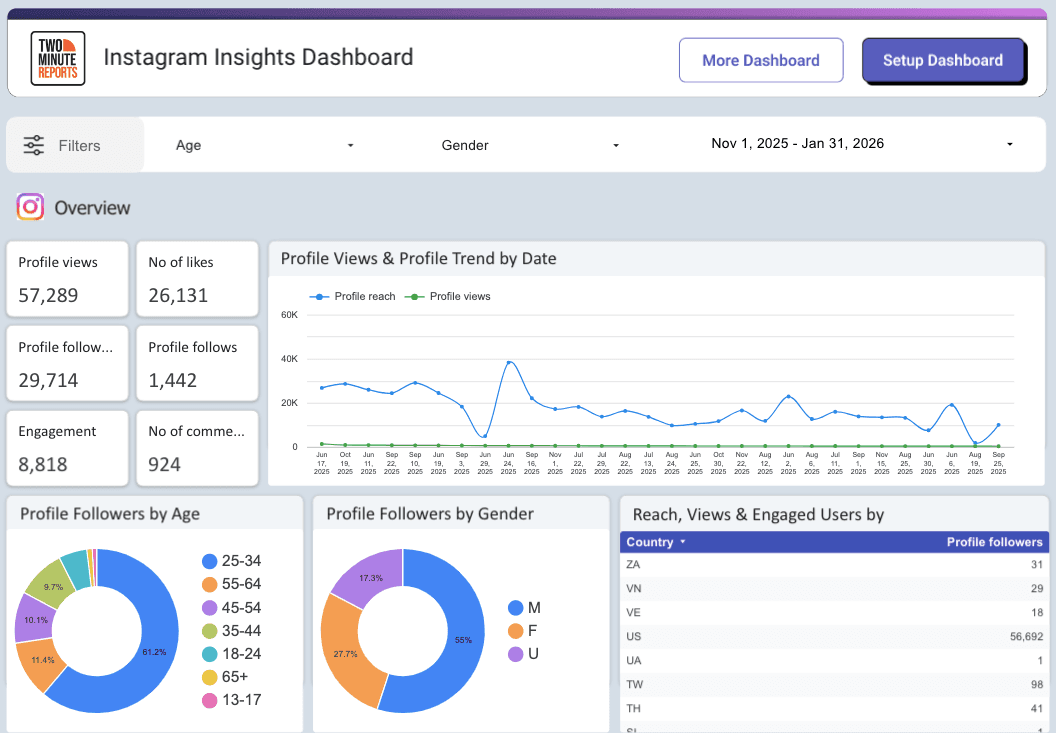
3. Social Media Marketing Report
A great social media marketing report should offer clear insights into how your audience interacts with your content. While native analytics from social media platforms are useful, they often lack customization and strategic focus.
With Two Minute Reports’ social media reporting templates, you can easily track your client’s performance across Facebook, Instagram, LinkedIn, etc and gain data-driven insights to refine your strategy.
Key social media metrics to track:
- Audience engagement: Measure overall engagement rate to improve visibility and authenticity.
- Reach and impressions: Track how far your content resonates and how often it’s seen.
- Platform performance: Compare how each platform contributes to your client’s goals.
- Follower growth: Monitor changes in your follower count and audience demographics.
- Content effectiveness: Analyze which content types drive the most engagement (images, videos, stories, etc)
4. Ecommerce Marketing Report
Whether you’re using Shopify, Amazon or WooCommerce, Two Minute Reports offers ready-made ecommerce marketing report templates to easily gauge your sales performance in a centralized dashboard. Here’s how you can optimize your ecommerce ROI:
- Sales Performance: Monitor revenue, profit margins, and conversion rates across multiple clients.
- Order history: Keep track of total orders, average order value, and order frequency.
- Customer behaviour: Analyze customer journeys and repeat purchases.
- Inventory management: Track stock levels, best-selling products, and restock needs.

5. Email Marketing Report
Hitting “send” isn’t enough. To understand how your email campaigns impact your client’s bottom line, you need a detailed email marketing report. With Klaviyo email marketing templates, you can measure email campaigns, subscriber activity, bounce rate, etc. Here are the key actions you can perform:
- Open rate: Track how many recipients opened your email to gauge interest.
- Click-through rate: Measure how many recipients clicked on links in your email to track CTR.
- Bounce rate: Monitor how many emails were undeliverable to maintain list health.
- Unsubscribe rate: Check how many people opt out to identify potential issues with your campaign messaging.
- Conversion rate: The percentage of email recipients who completed a desired action.

6. Web Analytics (GA4) Report
Navigating GA4’s native dashboard can be frustrating, especially when trying to create custom reports amidst a cluttered interface. Whether you’re optimizing your own website or tracking client performance, our GA4 reporting templates make it easier to extract KPIs and prepare custom reports that highlight the true impact of your marketing efforts.
Key GA4 metrics to track:
- Website traffic: Monitor overall website visits and session trends over time.
- User engagement: Track key interactions, such as pageviews, events, and session duration.
- Conversion rate: Measure the percentage of visitors completing desired actions (e.g., purchases, sign-ups).
- Bounce rate: Identify how many visitors leave your site without interacting, indicating content or usability issues.
- Goal completions: Track the completion of set goals (e.g., form submissions, purchases) to measure success.

7. CRM Report
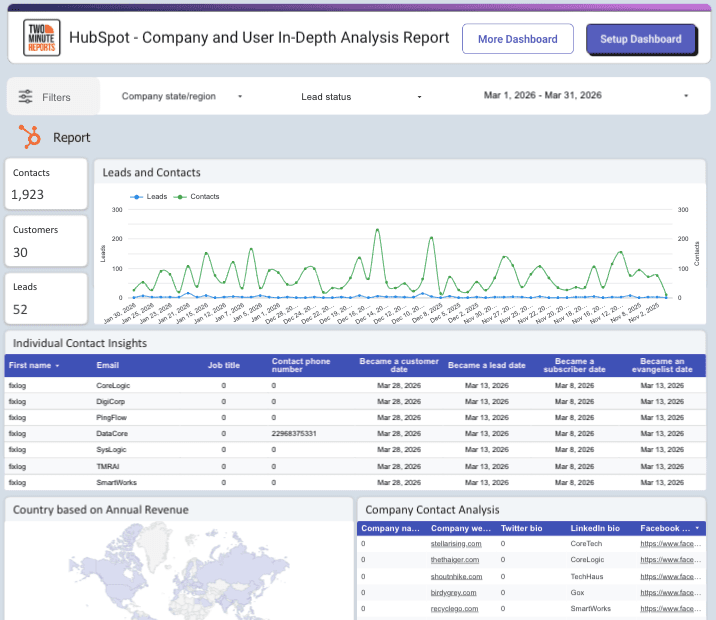
Native CRM reporting tools offer valuable customer insights, but they can become complex when scaling for multiple clients. With our HubSpot reporting templates, you can streamline and centralize customer data, making it easier to track and optimize interactions. This allows you to make informed decisions that positively impact your business strategy.
Key HubSpot metrics to track:
- Customer acquisition: Measure how new customers are acquired and their cost.
- Lead conversion rate: Track how many leads are converted into paying customers.
- Engagement levels: Monitor interactions with emails, forms, and workflows to gauge interest.
- Customer lifetime value: Track the total revenue generated from a customer over their relationship with your business.
Best Practices for Building Insightful Marketing Reports
You’ve come this far–well done! Now, it's time to get into action.
In this section, we’ll cover the 5 best practices for crafting actionable marketing reports to WOW your clients.
1. Highlight your marketing strategy
As a marketer, you pour your creativity into developing strategies that boost your client’s online presence. But does it matter if your clients don’t understand the reasoning behind your campaigns?
To bridge this gap, discuss the following with your client and include key insights in your marketing report:
- What is the current scope of the project?
- Which demographics does the target audience ideally reflect?
- What are the prime marketing channels driving profits?
- What are the future growth areas likely to be focused on?
- How are the trends performing compared to the previous report?
By addressing these questions, you provide clients with a comprehensive understanding of how your efforts align with their goals–showcasing your strategic value.
2. Have a defined marketing reporting structure
One of the pivotal points of building useful marketing reports lies in how you properly structure them. Your audience should easily grasp the insights you present on each page of your marketing report.
Here’s a simple 6-step breakdown for structuring your report:
Step 1: Introduction - A cover page summarizing the report: client name, type of report, date range, and channels covered.
Step 2: Outline of previous action items - Recap of major highlights and actions taken.
Step 3: Goals - Mention realistic benchmarks for evaluating success.
Step 4: Current KPI performance - Analyze relevant metrics from selected marketing channels to derive marketing outcomes.
Step 5: Trends and distribution - Illustrate growth and your client’s competitive standing.
Step 6: Practical recommendations - Offer actionable suggestions to enhance your client’s marketing strategy.
A clear structure allows clients to quickly locate the information that matters most to them, even at a glance. That’s how an ideal reporting structure is meant to be.
3. Use AI Insights to analyze campaign performance faster
A strong dashboard is the foundation of scalable client reporting. It standardizes KPIs, keeps period-over-period comparisons consistent, and gives every stakeholder a single source of truth.
But building the dashboard is only half the job. The real bottleneck is interpreting it: reviewing changes, spotting unusual patterns, and turning performance data into clear narratives for your clients.
Two Minute Reports handles both. You can connect your marketing data directly to Claude and ChatGPT through native AI integrations – with no additional platform cost. Ask questions in plain English, investigate performance changes instantly, and generate sharper client insights in seconds.
4. Report consistently to your clients
Regular communication is key, but finding the right reporting frequency can be challenging, especially with clients who have varying expectations. Here’s how to balance it:
- Weekly marketing reports track short-term activities, such as social media engagement or web traffic. Ideal for teams to monitor progress closely.
- Monthly marketing reports provide a broader overview, perfect for longer campaigns that need ongoing optimization.
- Quarterly marketing reports are comprehensive, reflecting overall performance against set goals and guiding long-term planning.
Choose a reporting frequency that aligns with your client’s business objectives, ensuring they receive updates that matter to them without feeling overwhelmed. It fosters accountability and develops a sense of trust & collaboration.
5. Refrain from building data silos


Agencies often face the challenge of fragmented data across departments. Siloed data can lead to inefficiencies and poor decision-making, limiting your growth spectrum. To prevent this, establish a unified data repository that integrates information from all relevant teams.
This approach ensures that everyone has access to consistent and accurate data, leading to better collaboration and more informed decisions.
Automate marketing reporting with Two Minute Reports
Are you winning or losing your marketing game?
The answer is in your marketing reports. After all, what gets measured gets improved.
From numbers to narrative, your reports should spotlight the key metrics that truly impact your client’s goals. By focusing on the data that drives results, you can not only track performance but also highlight the value your agency brings to the table.
For agencies looking to enhance their client reporting process, Two Minute Reports acts as a game-changer. It has everything your agency needs to streamline and automate marketing reports without any manual effort. Getting started is very easy:
- Choose from 30+ marketing and advertising platforms to connect with Google Sheets or Looker Studio.
- Select a marketing report template from the list mentioned above.
- Customize the template by including relevant KPIs, logos, and narratives.
- Set up custom refresh schedules to automate report delivery to your clients.
Bonus: Reuse existing reports across multiple clients so you don’t have to start from scratch.
This simple 4-step workflow helps you to deliver meaningful marketing reports that resonate with clients without adding extra workload. Try Two Minute Reports free for 14 days and create your first automated client report within minutes.
Frequently Asked Questions
It depends on how often your clients want to review the status of their campaign performance. But as a practice, you can choose to send marketing reports daily, weekly or monthly based on the type of campaigns you run for your clients.
A good marketing report clearly tells you what your next opportunities are. To make your marketing reporting sound actionable, identify its purpose, know for whom you are creating it, and collect only relevant data. Last but not least, incorporate engaging visuals that tell a story.
KPI reporting explains whether your marketing strategies and efforts fulfill your client’s business goals and objectives. For example, if you run a brand awareness campaign, the key KPIs will be impressions, reach, branded search volume, follower growth percentage, etc. Tracking and monitoring relevant KPIs will reflect how well you’ve executed the campaign.
There are four crucial steps to writing a successful marketing report: identifying the purpose or vision, understanding our target audience's needs, collecting ideal reporting resources, and leveraging data visualization to tell a compelling story.
Depending on the requirement, you can use various types of reports in marketing. Some of them include a marketing performance report to unify KPIs, campaign reports to measure specific results, social media reports to monitor content effectiveness, and so on.
An ideal marketing report should be consistent, organized, coherent, relevant and accurate to make informed data-driven decisions.
Related Blogs





Meet the Author
Shalini MuruganShalini is driven by ideas that create a tangible impact. At Two Minute Reports, she specializes in content that helps marketers optimize their reporting workflows. When she's not transforming complex data into meaningful insights, you might find her lost in a book, jotting down ideas in her notebook, or connecting the dots others overlook.
