
Summarize this blog post with:
Funnel has revised its pricing multiple times in early 2026, removing its free plan entirely and landing on a Starter plan that currently sits at $200/month. For teams that relied on the free tier to test the platform or were comfortable with the older pricing, this is a significant shift worth understanding before renewing or signing up.
This guide breaks down the new plans, what Flexpoints actually cost in practice, and where the hidden costs tend to show up as your data needs grow. We also compare Funnel with Two Minute Reports so you have a clear picture of what each platform delivers for the price.
Is Funnel a Reporting Solution?
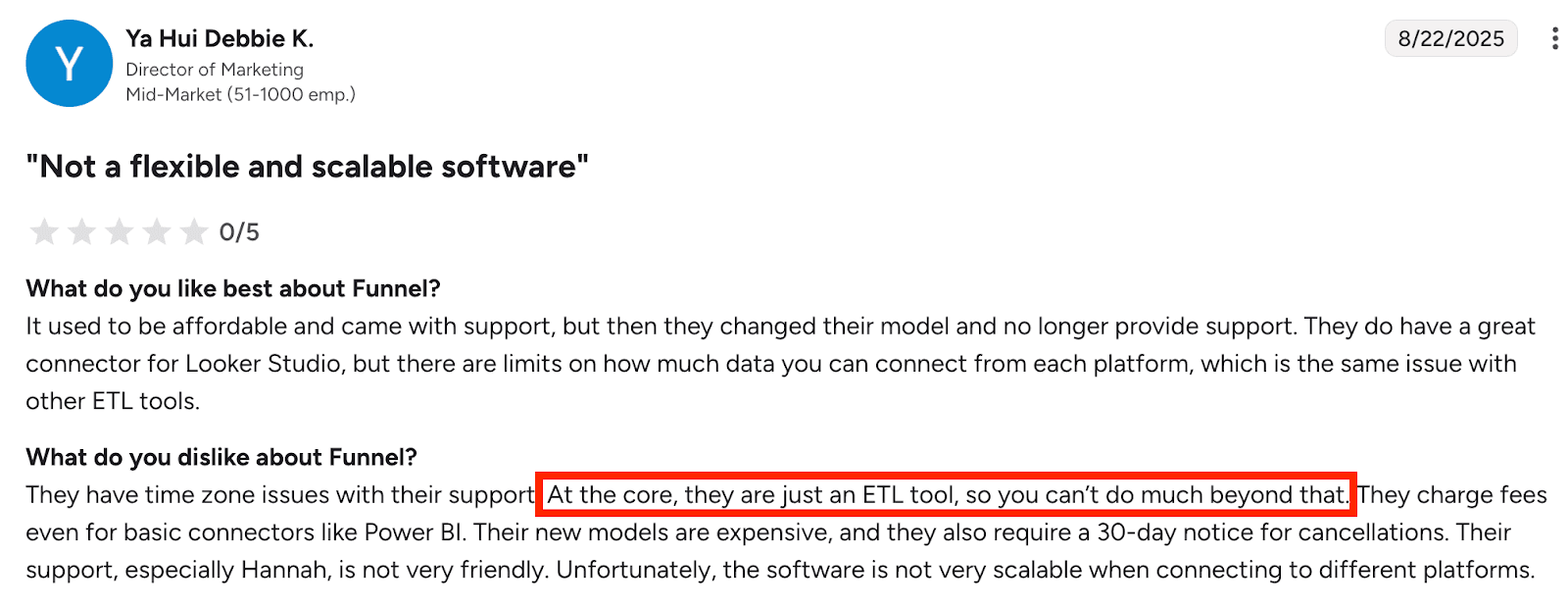
At its core, Funnel handles the data pipeline, not the reporting. It gets your data where it needs to go, clean and structured. What you do with it after that, building dashboards and reports, still requires a separate tool. As one verified G2 reviewer puts it: "At the core, they are just an ETL tool, so you can't do much beyond that."

What Changed with Funnel Pricing in 2026?
Funnel pricing changes occurred in three waves, a few months apart, and each narrowed the options for teams not ready to commit.
Here is a quick timeline of what happened:
December 2025: The free plan was closed to new users with no like-for-like replacement introduced.

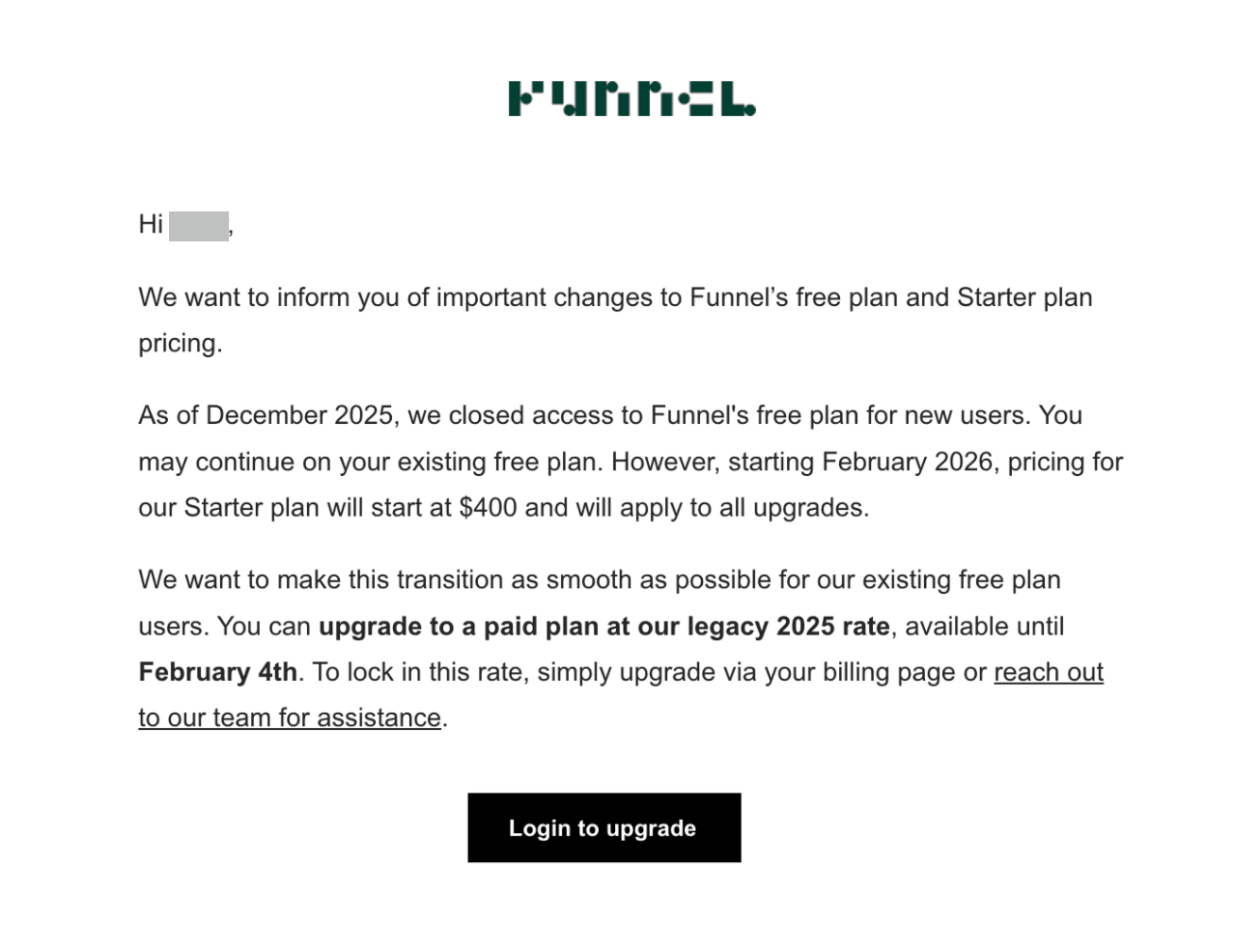
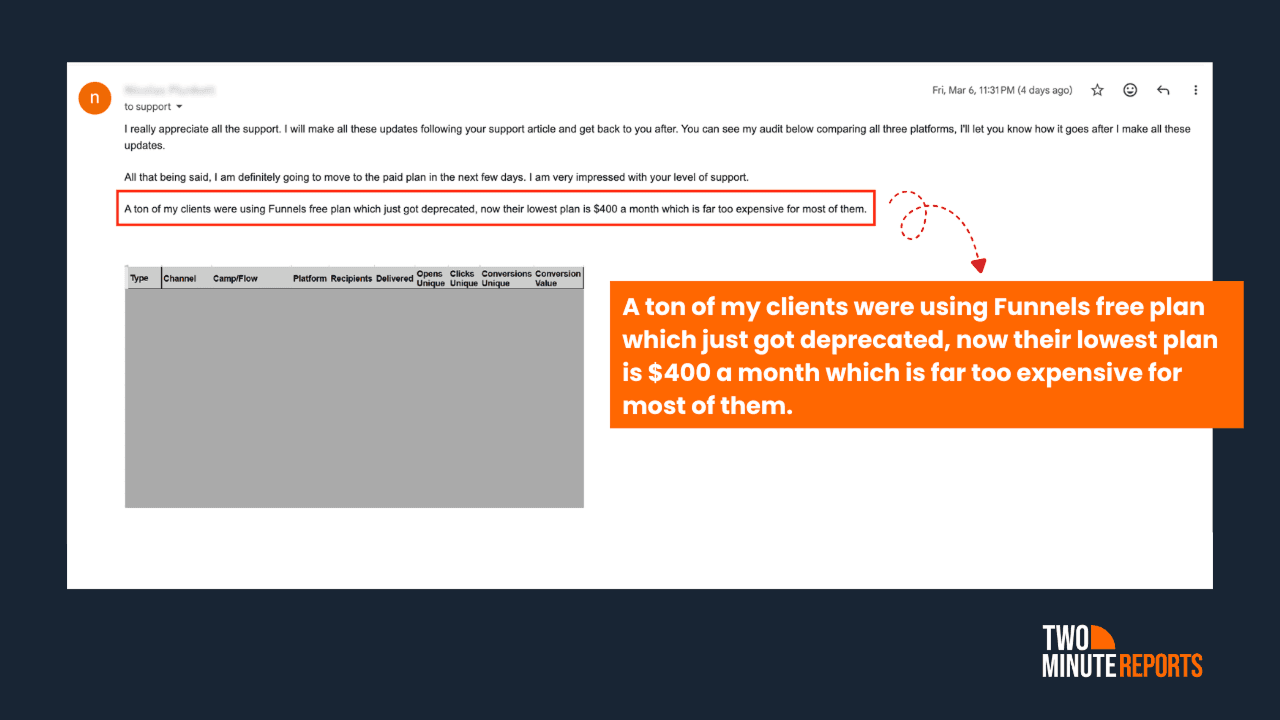
February 4, 2026: A new Starter plan was introduced at $400/month, replacing the free tier entirely. For teams on legacy pricing ranging from $120 to $240 per month, this was a significant overnight jump.

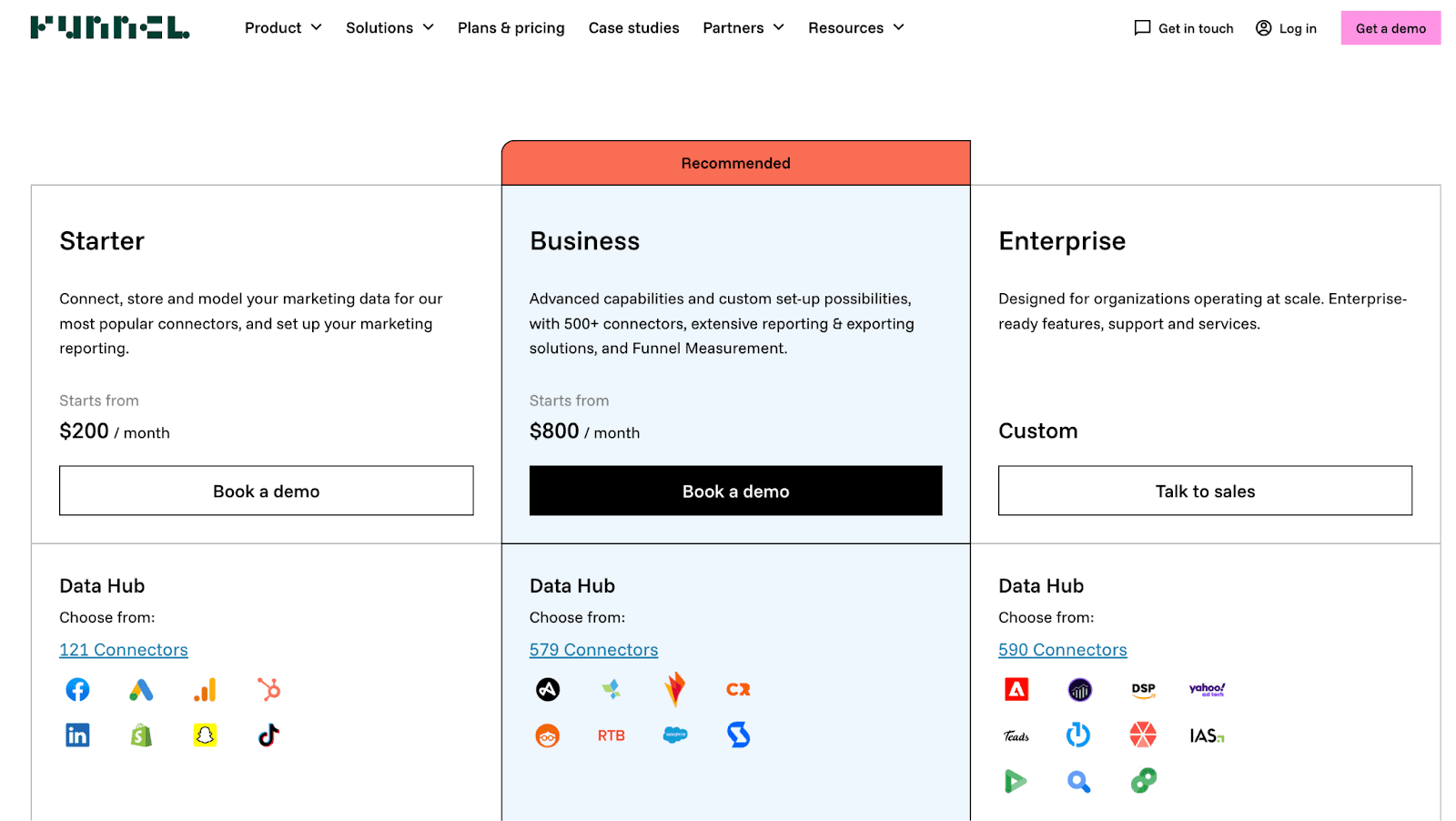
March 10, 2026: Funnel reduced the Starter plan to $200/month; it is now officially listed on their pricing page. The Business plan is listed at $800/month. Enterprise remains with custom pricing. Whether this reduction was in response to user pushback or part of a broader pricing strategy shift is unclear, but the $400/month price point did not last long.

What has not changed throughout this is how billing works. The Funnel platform operates on a Flexpoints credit system. The $200/month is not a flat fee. Each additional connector, destination, or refresh cycle reduces your credits, and once they run out, costs increase. For teams that are scaling or experimenting, that adds up faster than expected.
Funnel Pricing Plans (2026)
Funnel currently offers three paid plans. Here is what each one includes:
Note: The free plan is no longer available to new users as of December 2025.
Funnel has since officially listed the Business plan at $800/month on its pricing page, a price that was previously only surfacing in Reddit discussions. If that puts it out of reach for your team, our breakdown of Funnel alternatives is a good place to start.
Funnel’s Flexpoints: Why Your Bill Never Stays the Same
Funnel uses an internal credit system called Flexpoints, which is where predictable pricing becomes complex. Every action on the platform reduces your credits:
- Connecting a data source consumes points.
- Adding a destination (Looker Studio, Power BI, etc.) consumes points.
- Increasing data volume or refresh frequency also uses points.
What this means in practice:
- The $200/month Starter plan is not a flat fee—usage determines how far your credits go.
- Costs can escalate quickly if you add channels, clients, or increase refresh rates.
- Flexpoints do not scale linearly, so adding even a small new source can push you into higher usage tiers.
- There’s no public rate card for Flexpoints, making it hard to forecast your exact monthly bill.

 Reddit Source
For agencies or teams managing multiple clients, this is the part of Funnel's pricing that causes the most friction.
Hidden Costs to Watch
The plan price is only part of what you will actually pay. Here are a few costs that tend to catch teams off guard:
1. Visualization tools are not included: Funnel gets your data to Looker Studio, Tableau, or Power BI. What you do with it from there still comes at a cost, whether that is a paid license for the visualization tool itself, or the time and expertise needed to manage and maintain it.

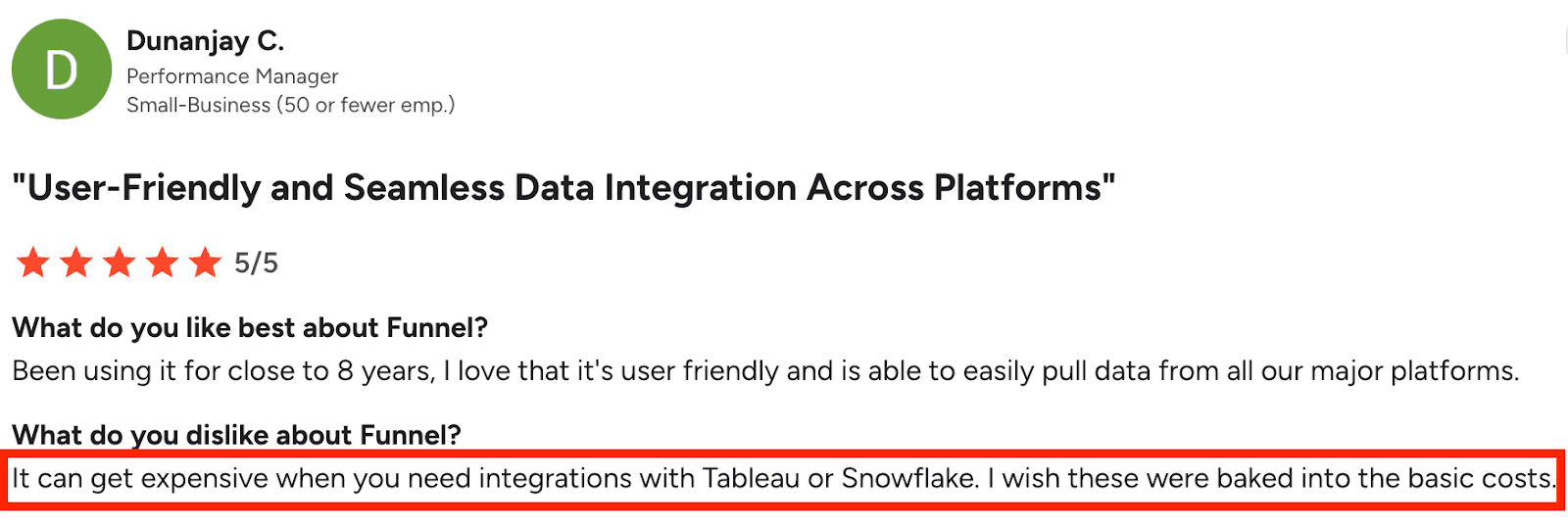 Verified G2 Review
2. Advanced measurement is a paid add-on: Features like marketing mix modeling and attribution are not bundled into any plan. They require a separate conversation with sales and a separate line item in your budget.
3. Business and Enterprise plans typically require annual contracts: Monthly flexibility is largely a Starter plan privilege. At higher tiers, you are likely committing to a full year upfront.
When you add it all up, the plan price is rarely what teams end up paying. Visualization tools, measurement add-ons, and Flexpoint overages can push the real annual cost well beyond what the pricing page suggests.
Funnel vs Two Minute Reports (Real Price Estimator Test)

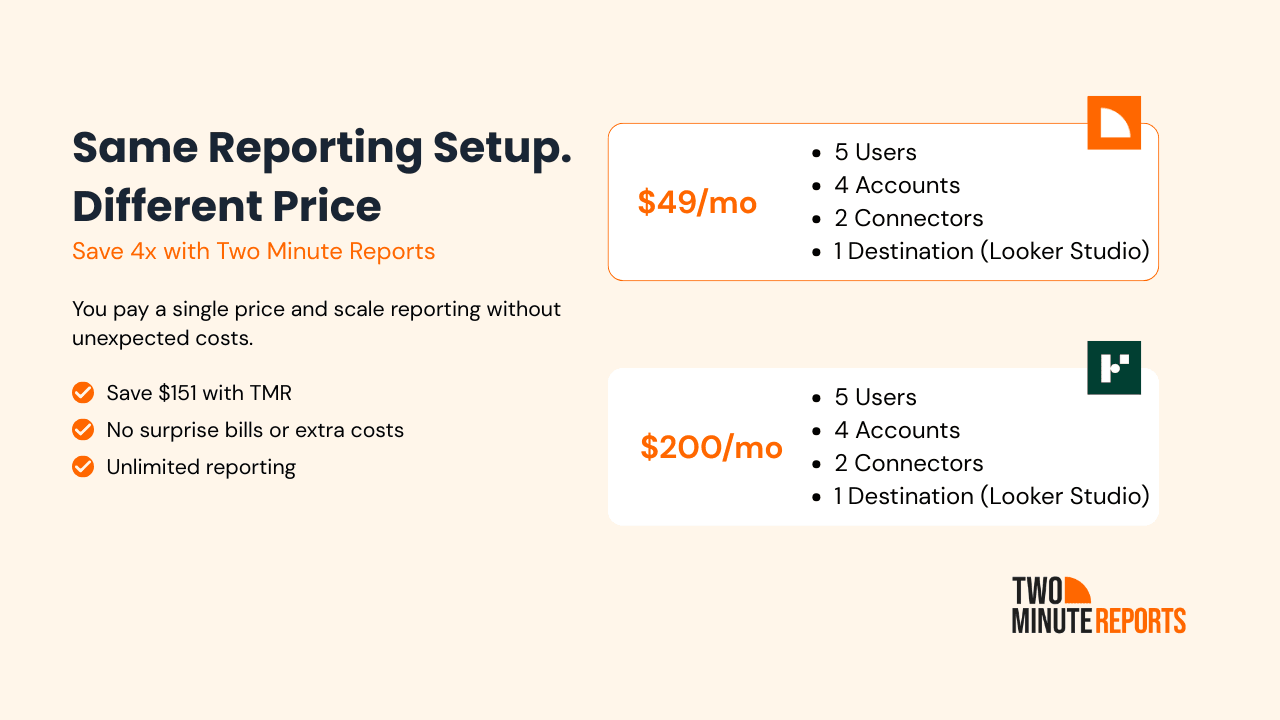
To make this comparison concrete, we ran the same setup through both platforms: 2 connectors, 4 accounts, and 1 Looker Studio destination.
On Funnel's Starter plan ($200/month), that setup consumed 390 out of 400 Flexpoints, leaving virtually no room to add anything else before hitting the plan ceiling.
On Two Minute Reports, the same setup costs $49/month.
That is a $151 monthly saving for an equivalent reporting setup. Annually, that is $1,812 back in your budget.
No Flexpoint surprises, no usage-based billing, just a straightforward price.
Funnel’s Pricy Price Tag Nobody Talks About
The $200/month Starter price looks manageable on paper. Here is what it actually looks like when you compare plans side by side.
1) Solo and Small Marketing Team
Funnel’s Starter plan costs $200/month = $2,400/year
Two Minute Reports’ Basic plan: $49/month = $588/year
2) Mid-Size and Growing Agency
Funnel’s Business plan costs around $800/month = $9,600/year, with Flexpoints that continue to scale as your connector count, destinations, and data volume grow. The $800 is the floor, not the ceiling.
Two Minute Reports’ Pro plan starts at $99/month = $1,188/year, flat price with no usage-based surprises.
3) What Agencies and Enterprises Actually Pay
According to Vendr's transaction data, analyzing real Funnel contracts, the average annual spend is $73,500. Agency contracts typically range from $27,000 to $100,000+, depending on Flexpoint consumption, connector count, and data volume.
Two Minute Reports’ Business package starts at $499/month = $5,988/year, with 200 connections, 200 accounts per connector, and 15 users all included at a flat price.
Sources: Funnel pricing from official website (March 2026). Two Minute Reports pricing from the official website (March 2026).
Funnel vs Two Minute Reports: Side-by-Side Comparison
If Funnel's new pricing has you reconsidering, here's how Two Minute Reports compares on the things that matter most.
Who should use Two Minute Reports vs Funnel
Choose Two Minute Reports if this sounds like you
Two Minute Reports works best when your priority is to quickly deliver marketing data into reports without adding layers of complexity.
It’s a strong fit if:
- You want instant access without sales-led onboarding
- You need transparent pricing (monthly or yearly) with no surprises
- Your reporting stack is built around mainstream marketing platforms like Google Ads, Meta Ads, TikTok, LinkedIn, and more
- You or your team will be owning reporting directly, not relying on engineers
- You need to deliver client-ready reports fast, not after weeks of setup

Choose Funnel if this sounds like you
Funnel is designed for teams dealing with large-scale, fragmented, and highly customized data environments.
It’s a better fit if:
- Your stack includes 100+ data sources, including non-standard platforms
- You need data transformation, normalization, and mapping at scale
- You have a data team managing pipelines and workflows
- Advanced use cases like multi-touch attribution or custom data modeling are critical
- You are already invested in Funnel, and migration costs are high
7 Reasons Marketing Teams Choose Two Minute Reports Over Funnel
Now that you understand what Two Minute Reports offers, here’s why marketing teams choose it over Funnel:
From data to report in one workflow: Connect your sources, visualize your data, and share your reports without switching between tools. No pipeline setup, no waiting. Just a single flow from start to finish.
Pricing that does not lock you in: Monthly or yearly, you pick what works for your team. No annual contracts, no usage-based billing, and no surprises when your data volume grows.
Less configuration, more insight: Funnel requires data mapping and transformation before your data is usable. Two Minute Reports works with your marketing data as is, so you spend your time on analysis, not setup.
Built for marketers, not engineers: Every connector, every dashboard, every feature is designed for the person running campaigns, not the person managing data infrastructure. That means faster onboarding, quicker iterations, and no dependency on a technical team to keep things running.
No credit card required to start: You can try Two Minute Reports free for 14 days without a credit card. Funnel requires a demo call before you can even see the platform.
Error notifications out of the box: When a query fails, you know about it immediately. No manual alert setup, no discovering broken reports during a client presentation.
Transparent self-serve pricing: Every plan, every price is listed publicly on the website. No "talk to sales" to find out what you will pay.
How to Switch From Funnel to Two Minute Reports
Switching doesn’t require a complex migration. Most teams get started in a few steps and validate as they go.
1. Start with a 14-day free trial to explore the Two Minute Reports platform before committing
2. Choose your reporting destination, Google Sheets or Looker Studio, based on your workflow
3. Connect your marketing platforms, select accounts, and start pulling data in a few clicks (no API setup required)
4. Recreate one or two existing reports and run them alongside Funnel to validate data accuracy
5. Compare metrics and outputs to ensure everything aligns before fully switching
6. Review your Funnel billing cycle and cancel in advance (30-day advance notice) to avoid an extra charge
Need help? Reach out to our support team for assistance with setup, report recreation, and a smoother transition
Make The Switch with Two Minute Reports’ Free Trial
If your reporting workflow feels slower than it should be, that’s usually a sign it needs simplifying.
Two Minute Reports is built for teams that want to connect data, build reports, and move on to analysis, without getting stuck in setup or pricing complexity.
You don’t need to migrate everything at once. Start with one report, validate the data, and scale from there.
Try it for yourself
- 14-day free trial with full feature access
- No upfront commitment
- Monthly and yearly plans with clear pricing
Or take a closer look first:
- Explore Google Sheets and Looker Studio dashboards
- Learn how to track cross-channel performance
Frequently Asked Questions
Two Minute Reports supports the most widely used marketing platforms. If you rely on a niche source, it’s best to check availability beforehand or reach out to the support team for guidance on alternatives.
Yes. You can bring data from different sources into a single report using Google Sheets or Looker Studio and analyze performance across channels without needing complex setups.
Pricing is structured and transparent, with clear monthly and yearly plans. As your usage grows, you can upgrade based on your needs without unexpected mid-cycle charges.
You can connect your platforms and start building reports within minutes. Most teams have their first working report ready in an hour, especially when starting with familiar platforms like Google Ads or Meta Ads.
No. Two Minute Reports is designed for marketers, so you can connect data sources, build reports, and schedule refreshes without relying on engineers or handling APIs.
Related Blogs




Meet the Author
Shabika VenkidachalamShabika, at her core, is a storyteller who believes even data-heavy topics can be infused with heart. At Two Minute Reports, she blends creative writing with user intent to create clear, purposeful content that is deeply human. Away from her desk, she finds inspiration in nature, where creativity flourishes without distractions.
